
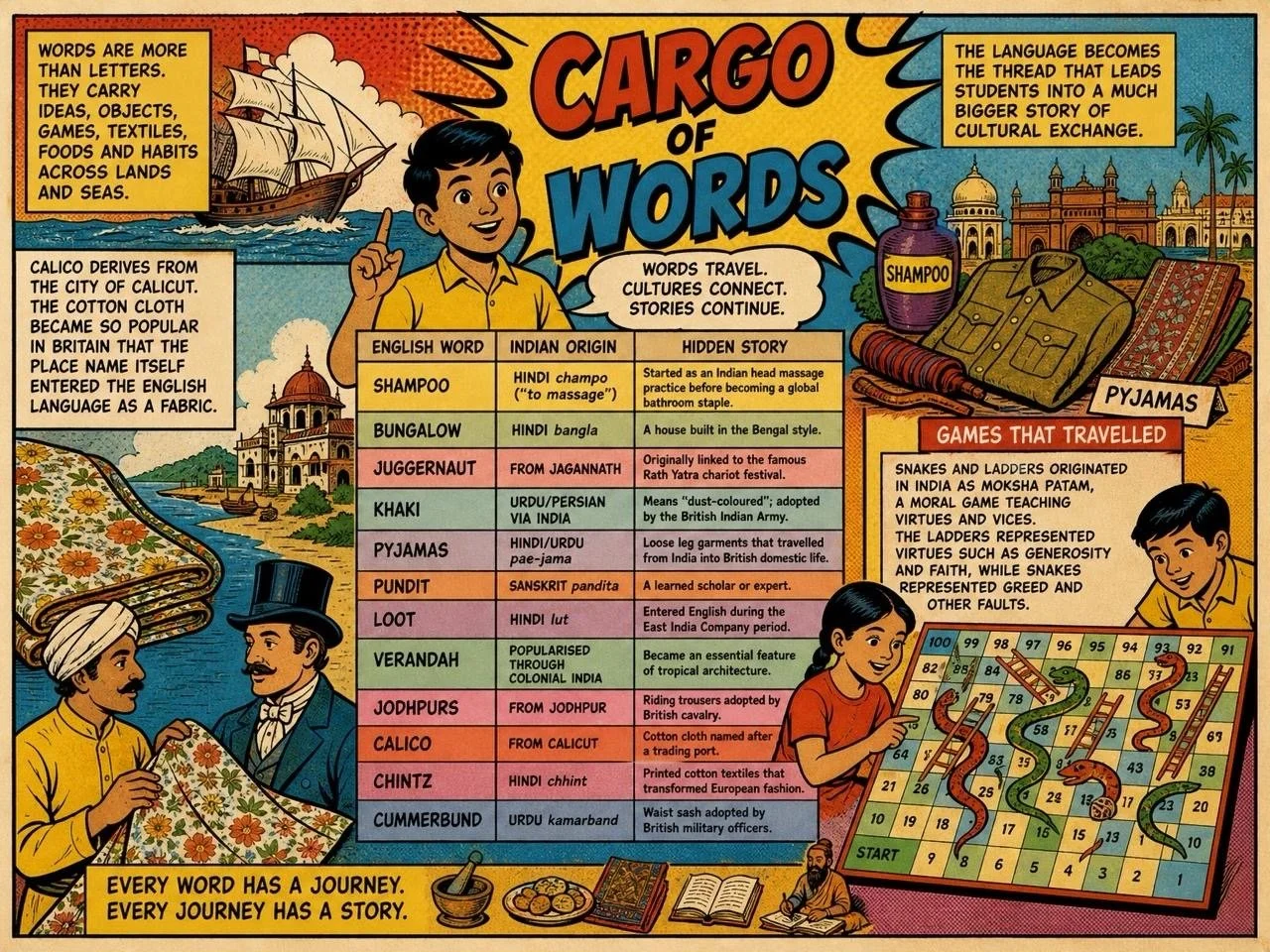
CARGO OF WORDS
*
CARGO OF WORDS *
CARGO OF WORDS is an innovative digital heritage idea that reimagines how 400 years of British-Indian cultural exchange can be experienced by young audiences. Developed in response to the Purfleet Heritage & Military Centre's ongoing engagement with schools, the project addresses the Centre’s need for more dynamic, accessible, creative and participatory approaches to history and heritage learning. This is an ongoing project and will expand its activities over time.
The project is in partnership with the Purfleet Heritage and Military Centre, bringing together expertise in heritage interpretation, creative technology and community engagement. Developed by a diverse team of artists, designers, historians and creatives of Indian heritage, the project reflects the multicultural stories it seeks to tell while offering new opportunities for underrepresented voices to contribute to public history.
At its heart, Cargo of Words explores the remarkable journeys hidden within the language we use every day. Familiar English words such as shampoo, bungalow, juggernaut, khaki, pundit, loot, jodhpurs, pyjamas, calico, chintz and cummerbund all originated in India, travelling across oceans through trade, migration, empire and cultural exchange before becoming part of everyday British speech. Most people use these words without ever realising that they are living evidence of centuries of interaction between Britain and the Indian subcontinent.
The project reveals how words are far more than static units of language. They are living cultural artefacts, shaped and reshaped by generations of movement, encounter and adaptation. Hidden within a single word are stories of merchants, sailors, soldiers, migrants, artisans, scholars and communities whose lives intersected across continents. Words become gateways into mutual cultural discovery, revealing how identities, traditions and ideas continually travel, overlap and evolve.
Cargo of Words uses interactive 3D digital "cargo barrels" as playful vessels of discovery. Students will be invited to "unbox" barrels on their phones, tablets or computers, revealing the hidden stories behind familiar words and cultural objects. Each barrel acts as a portal into a wider narrative, transforming language into an engaging journey through history.
The project extends beyond vocabulary to explore the movement of ideas, games, textiles and cultural practices. For example, many young people are surprised to learn that Snakes and Ladders originated in India as Moksha Patam, a game designed to teach moral and spiritual values, or that modern chess evolved from the ancient Indian game Chaturanga. Similarly, words such as calico and chintz reveal the global influence of Indian textiles, while shampoo reflects the adaptation of Indian wellness practices into everyday British life. These examples help students understand that cultural exchange is not an abstract concept but something embedded within daily routines, language and leisure.
By connecting familiar objects and words to their historical origins, the project encourages curiosity, empathy and a deeper understanding of Britain's multicultural heritage. Students discover that history is not a distant archive of dates and events but a living conversation that continues to shape contemporary society.
Designed as a mobile-first experience, Cargo of Words extends learning beyond museum walls and directly into classrooms, homes and communities. The project is particularly focused on engaging young audiences across Arts Council England Priority Places, including Thurrock and Basildon, ensuring that high-quality digital heritage experiences are accessible regardless of location or background.
By blending rigorous historical research with innovative digital storytelling, Cargo of Words offers exceptional public value and a scalable model for future educational and cultural initiatives. It demonstrates how heritage can be activated through creativity and technology, broadening access to history while fostering cultural understanding and belonging.
Ultimately, Cargo of Words invites young people to look again at the language they use every day and to recognise it as cultural cargo: a collection of stories, memories and connections carried across centuries. Through words, they discover that British and Indian histories are not separate narratives but deeply intertwined journeys that continue to shape the world around them.